
Memorial tunnel
Steyr 2013
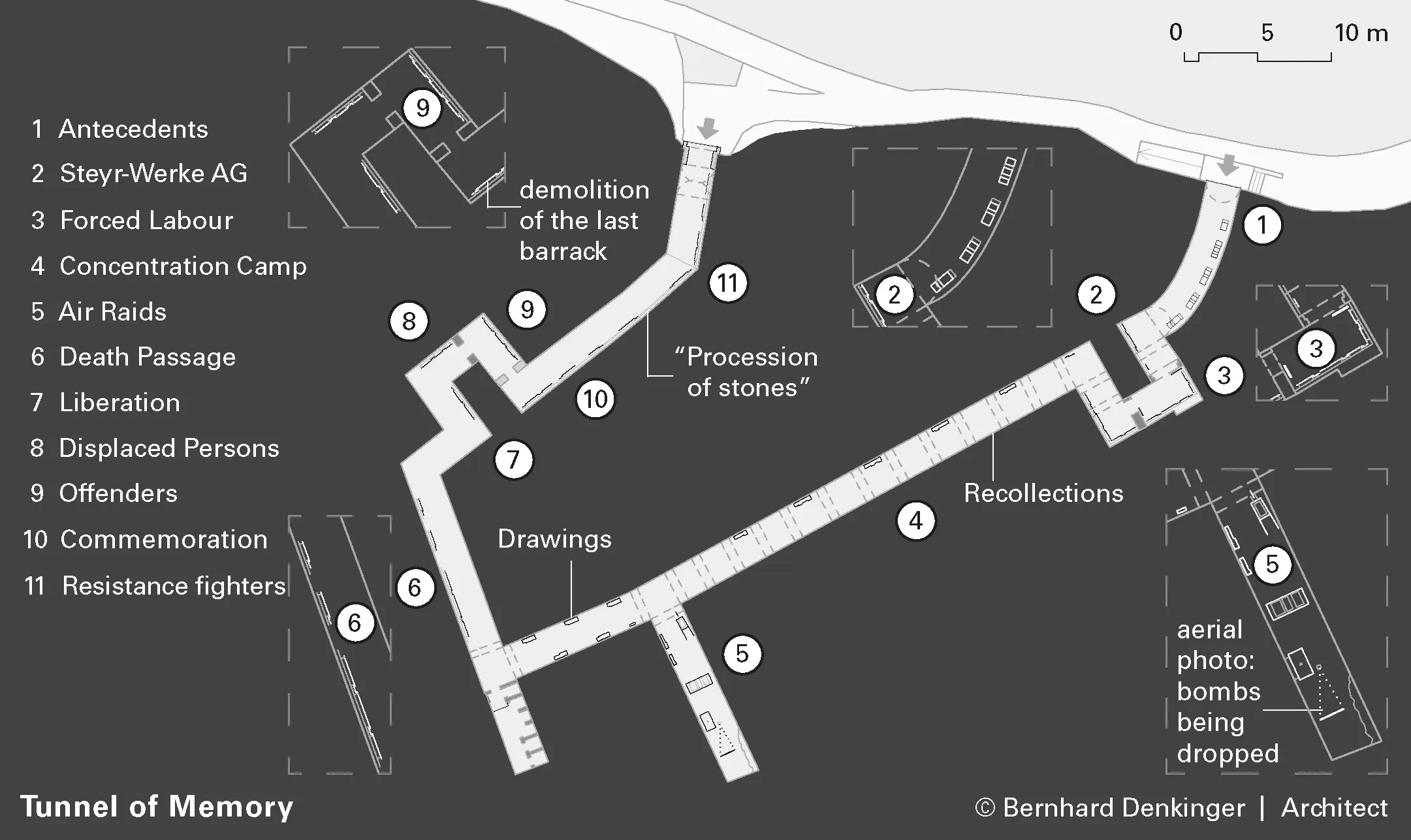
Permanent exhibition on the concentration camp and forced labour in Steyr in a 160 m underground bunker. The building was intended to protect the civilian population from bombing raids. The interior, protected area, was separated from the entrances by airlocks. The spatial and thematic center of the exhibition is a sequence of twelve light installations depicting the former Münichholz concentration camp. In the middle of the tour the function of the tunnel system and its construction by former prisoners are explained.
The tunnel has been left in its original character (built in 1943). Traces of the stone working, created in makeshift brickwork, can be clearly seen on the walls and ceilings. To achieve a tunnel profile with minimum heights of 2.10m, the floor had to be lowered. Excavating the stone under the existing floor, in some areas by an additional 40cm, provided the building’s new floor, which was then covered by compacted white limestone-gravel. The design divides the tunnel into contrasting sequences: rhythmically structured paths suggesting movement, more static and contemplative sections, and short meditative passages. The exhibiton’s light plays an important role. The tunnel is seen as a dark space separated from the outside world. The light carves zones out of the darkness in which the exhibition is presented. The light intensity varies during a visit. The subdued and diffused light of ’empty stretches’, which are just bright enough for the route to be seen, becomes more intense in the exhibition stations. This helps the visitor to understand the building’s qualities and it enabled us, the designers, to place stations separated by long distances, thus allowing the visitor gradually to discover the exhibition installations and the themes on display.
The three-dimensional design of the illuminated display elements with set-back parts and niches permits a layered perception, with various levels containing the very diverse exhibition-objects: pictures, documents, accounts and commentaries. When approaching the various stations the impression is of a wealth of pictures and documents or a series of texts that appear to stand out from the historical documents of the exhibition.
The entrance is next to a highly frequented path. The two outer gates got new steel and concrete frames that make the tunnel profile visible from the outside. When closed they form translucent walls. There are no door handles or visible entry signs. Likewise the signs outside are reduced to the necessary minimum: a sign on a backing made from laser elements and a small sign with opening hours.

“A unique exhibition has been created in the brick-lined tunnel of a Second World War air-raid shelter .....“
FX Design Magazine, London, October 2015
Client:
Verein Mauthausen Komitee Steyr (MHKS)
Idea:
Karl Ramsmaier
Scientific consulting:
Bertrand Perz
Content:
Regina Wonisch (Kuratorin), Karl Ramsmaier (MHKS), Adele Neuhauser (MHKS) und Team
Architecture | Design:
Bernhard Denkinger | Architekt
Photos:
Andreas Buchberger
Metal-work:
Gradwohl, Melk
Earth- and concrete works:
Held & Francke, Amstetten