Gravesite for Nazi victims
Katsdorf 2021
During construction work near Lungitz train station in 2018, a 120 m layer of ash was discovered under the tracks that differed markedly from normal track substrates. In view of the dating of the find (1930s to 1940s) and the proximity to Gusen and Mauthausen concentration camps, the ashes were thought to be the remains of burnt corpses, most likely from a concentration camp crematorium. They were removed from the track substrate and buried near Lungitz train station. The area where the ashes were buried is around 43 square metres in size.
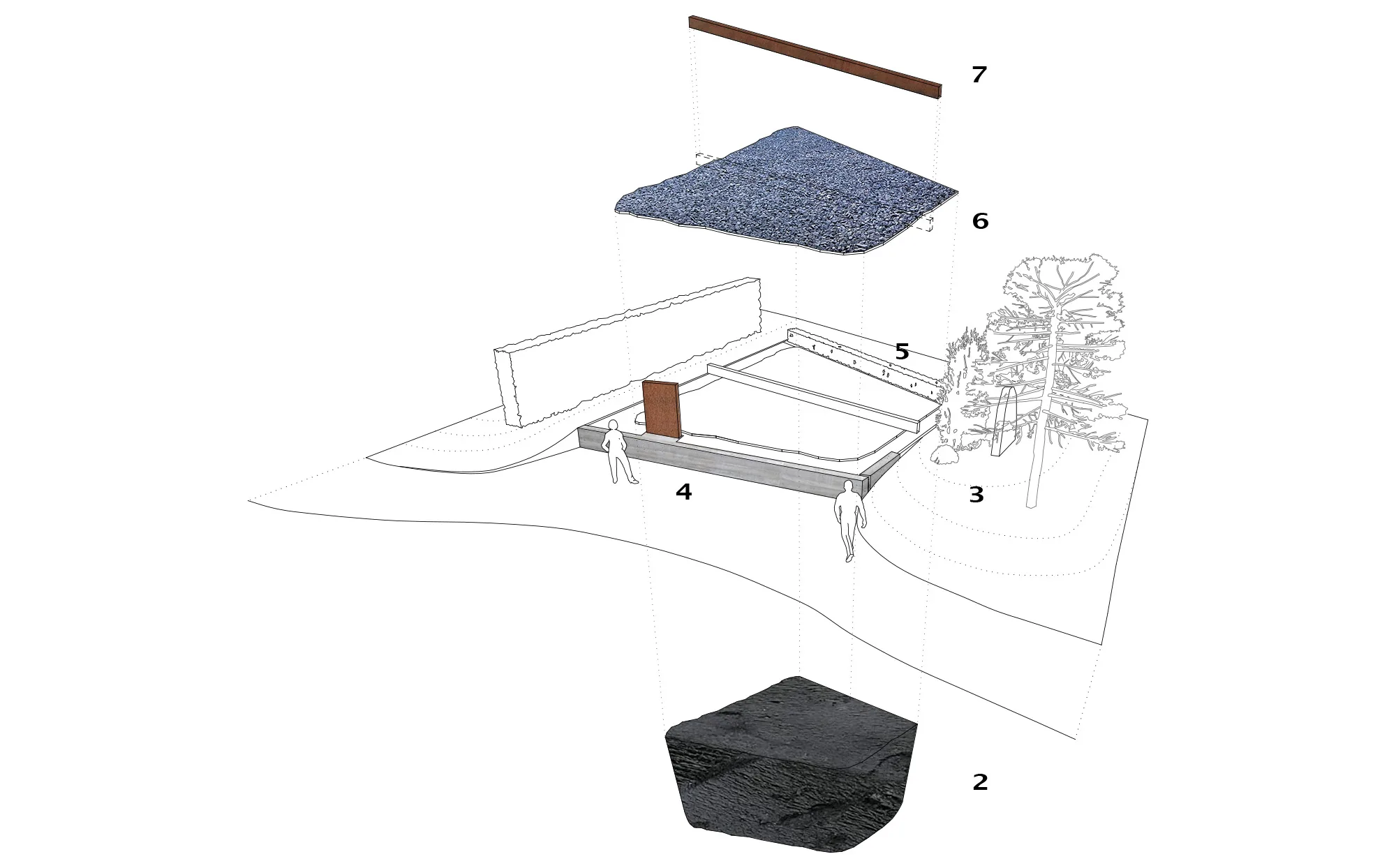
Our design marks the spot and visualises the position of the ash on the surface. It reflects the topography of the site, which slopes on two sides so that it “flows” under the installation until it reaches a concrete retaining wall running by the side of the road. On top of the wall is a stele displaying a short text. This element enters into a visual dialogue with an existing memorial stone. The site of the ash pit is marked with a dark-grey crushed basalt topping framed by a weathering steel strip following the irregular borders of the ash pit.
Bridging over the area is a beam-shaped element resting on foundations outside the area of the pit. A short section of standard Deutsche Reichsbahn rail, as used in the 1930s and 1940s, is placed on the upper side of the beam.
A hedge was planted along the southwest border of the site to create a visual barrier to the neighbouring site. The hedge is cut to a height of 60 cm so that the rising ground behind the installation, which leads to a wooded hill, can be seen from the access side. The concrete wall by the side of the road is covered with an imprint of rough-cut boards. Narrow boards were used for this, similar to the boards used in the 1960s for the exposed concrete walls of the Gusen Memorial.
Client:
Bundesministerium für Inneres – Abteilung IV/3
Architecture | Design:
Bernhard Denkinger | Architekt
Statics:
Gerald Gallasch
Photographs:
Stephan Matyus
Metal work:
Ing. H. Gradwohl, Melk
Earth and concrete work:
Held & Francke